Author: Donna Barratt

  • Caregivers Help Evade Life’s Chaos

    Dementia gives the feeling of not belonging. Discontentment with the current situation, and lost connections in memory that no longer give one a foundation for emotional security, merge creating great apprehension in our loved ones.  It is our job as caregivers to support physical, emotional, and mental health.  We want our “person” to know that she is safe with us, that we love her, and will always be there for her.  When that is accomplished and consistent, contentment and happiness is the result. However, it certainly is an up-and-down affair as the mind continues to lose those connections. It leaves the caregiver continually looking for new ways to give comfort, to calm, and to help them feel safe.


  • Caregivers Can Celebrate the Small Things

    Life is a journey filled with lessons, growth, and quiet moments that shape who we become. Every challenge teaches us strength, every failure brings wisdom, and every small step forward is a victory worth celebrating. When we learn to appreciate the present and trust the process, life unfolds in ways more beautiful than we ever imagined.

    This is a photo of one of my grand-dogs, Bianca. She would have been 15 this week. God took her to Pet Heaven last month.

  • Truth Goes Awry

    Truth Goes Awry

    Caring for an adult with dementia often requires some quick thinking.  When Marjory asked why none of her family had been to see her, I did stop and give it some thought before answering.  I went with the truth.  I told her they died and were in Heaven.  The look on her face, and the barrage of questions knocked me over.  Who killed them?  Will they come to kill me?  How come nobody told me they died?  

    I spent the rest of the day, and many days after that, trying to explain that they were not killed, they died at different times from various health reasons, and they all had separate funerals. She was shocked and it was too much for her to absorb.  After several months, she did forget that particular conversation, and talked about her family as though they all still lived on the farm where she grew up. 

    I learned a lot about dementia that day.  Now my husband and I are getting expert at ignoring certain conversations, changing the subject, or interrupting her thinking with ice cream, cookies.  All of those work well.  

    During that period of time, she asked me why, if her family was in heaven, they did not at least call her and let her know.  I told her I did not know, but if I go to Heaven first, I will definitely call and let her know that I am there. 

  • Whose Teeth Are on the Floor?

    Dementia robs memory.

    by Donna B. Barratt

    I am the caregiver for my mother-in-law who has dementia. She has only top dentures. Her lower teeth are natural. She used to take out her dentures and brush them daily, in the privacy of the bathroom. She wanted no one to know that she had dentures at all. Then, over time, as dementia robbed her of her memory, she forgot about them, what a toothbrush and toothpaste were for, and she did not understand when I tried to help with this task. As with other things, you just “go with it.” A person with dementia, who loses memories, will not get them back, and you cannot reason with them about those things, because they no longer exist in their mind.

    When you choose to accept becoming a caregiver for a loved one with dementia, you usually have little experience. If you read, you will be aware of issues that go along with that line of volunteer work, but until you have actually done it, you cannot really know what it will require. And though I have been caregiving for my mother-in-law for almost three years now, I could never predict the many things that happen.

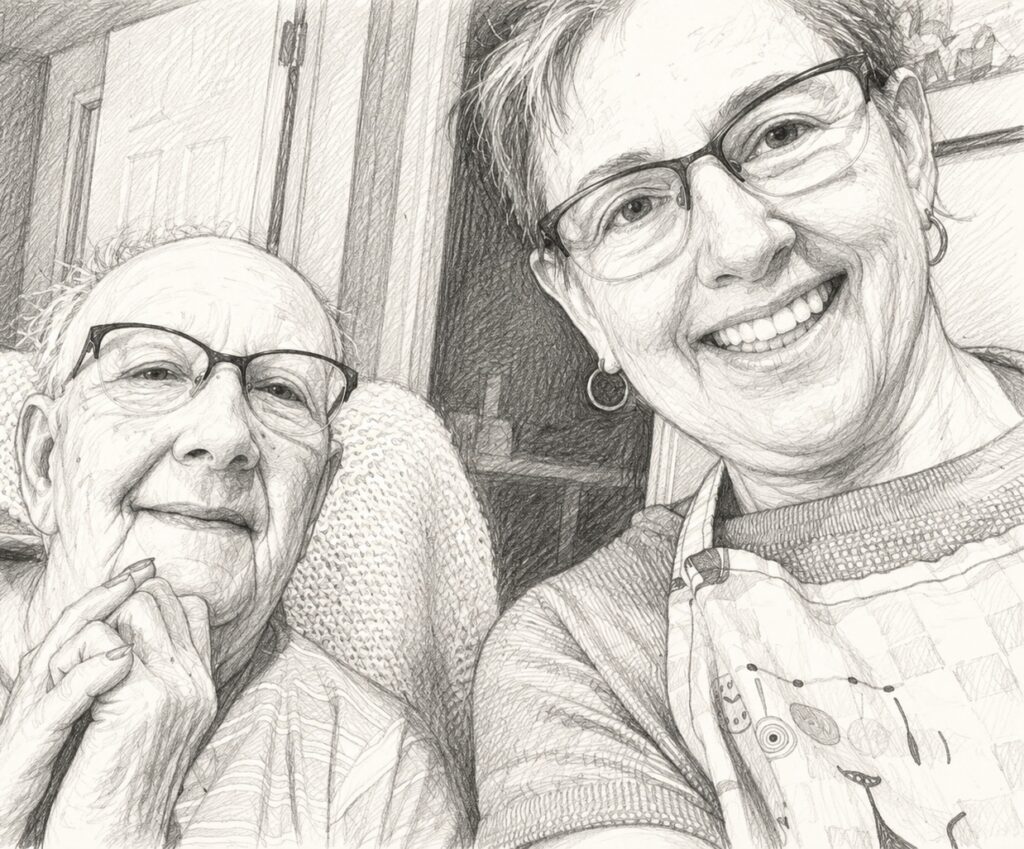
    Me and “Mama” sharing life.

    So you might imagine what happened the morning I walked in her bedroom, when the motion monitor signaled she was moving (which meant she was waking),and in the middle of the floor lay that top set of teeth. I picked them up. She looked at them in my hands. I said, “I think your top teeth came out.” She said, “All my teeth are in my mouth.” I handed her the dentures and she looked them over, then declared again they belonged to someone else, and handed them back.

    I looked at her and said, “feel in your mouth and check.” She said, “I don’t have to. I know I have my teeth and my teeth don’t come out.” I put them down and we dressed and went to the table for breakfast. I put the teeth on the table, near her, but not too near. I got her breakfast and thought about those teeth.

    I wondered if I got the toothbrush and showed her how to clean them, if she would remember doing that. So I did that. She watched me. I know that muscle memory is real and it might help her make the connection. She took a bite of her breakfast sandwich and I watched her. I could see that she felt something was different as she chewed. She was thinking and looking at the teeth on the table. Slowly, she picked up the teeth and started to brush them. She brushed them for about five minutes. Then I walked away to do something and when I returned the teeth were not longer on the table and “mama” was eating again. I did not say a word, nor did she. Life moved on that day and in her mind, the experience was totally gone.

    These are the kinds of things you do not read about in articles about caregiving for a dementia patient. Well until I wrote a book about my own caregiving experiences. It is in the publishing process now. I will let you know when “Conversations With a Caregiver” can be purchased. Thank you for reading my blog.

  • Be Present

    Is your heart in what you do each day?  Do you actively seek joy, connection, and communion with the beauty of the Earth? Are you able to move slowly, letting go of meaningless tasks and letting your senses lead you to an awareness of what is real and true in your surroundings?  Caregiving is a place where it is more important than ever to initiate a foundation in the present moment, based only on those things that bind you to real living; to a life that gives some meaning to what you believe. We are fashioned after a creator and are made to create.  Don’t shortchange your spiritual needs, your self-worth, or expressing your feelings in some new creative way.  Stop and let your mind and soul connect.  Give up trying to control anything.  Have you heard the phrase “Man plans and God laughs?”  Take a moment today and begin a new journey.  Stop making plans and start following what moves your spirit.  Play an instrument, walk and meditate, read a book, sit and look at the spring flowers, listen to a podcast that is uplifting or just listen to music that touches you deeply.

    Credit for picture and poetry: https://www.themarginalian.org/newsletter/


  • Training Wheels

    I told you in that first post that I was a teacher.  I am not a nurse.  I am a mom, but not a nurse.  Bandaid expert yes, but I consult Google for all things medical, because……I am NOT a nurse.  I can still get confused about the difference between Advil, Tylenol, and Ibuprofen. The positive side is we have Joyce, Calvin’s sister who is a retired nurse. Though she lives in San Diego and we are in Kansas City, she supports us in every way just like a pair of training wheels. Sometimes I say she is my choice when I need to “Phone a friend.”

    My husband and I realized there would be a very large learning curve to caregiving . When we took that first step into the curve, we entered the world of home health care. We found out right away that we could not get our mother in or out of the car without great difficulty. We recognized that going to doctor appointments and getting medical tests would require a hired transport. After research and talking to people in the medical field, we recognized that we should pursue home health care. Signing up with our choice company was not difficult and they responded with quality and effective care.   After a year,  however, a change in management, a stream of P.A.’s quitting, and lack of response to keep prescriptions up to date, required us to began a new search for a different company.  Finding one that came with great recommendations, we again, signed up, and have been more than happy with them.

    Next we began to call around to companies that provide senior help at home so we could have a break a few times.  It took a few months on a merry-go-round of caregivers before we found a winner.  I would recommend Senior Helpers in Kansas City any day of the week. I think they pay more than some, they provide training, and they work hard every day to be the best. I know they have a lot of clients, but when we call, they know we are Marjory’s caregivers and family.  They’ve won all kinds of awards. Our caregiver is young, has great experience and has helped us learn so much.  

    The third big part of moving through the learning curve was to find a reliable and reputable transport to take us in for scans that can’t be done at home.  We’ve had blood draws and x rays at home but some scans require the use of large machines. After about eight phone calls to companies that did not seem to know what they were doing or charging, I finally talked to a retired couple who had their own special van for transporting disabled and elderly patients.  They were a healthy break in the conversation and we hired them.  They were just as they seemed, reliable, kind, and helpful.  The costs runs pretty much the same across the reputable companies.  When we had an ice storm and everyone was rescheduling, they could not work us in, but recommended two other companies that turned out to be great as well.  It is not cheap, and insurance will not pay for non-emergency transport unless you require an ambulance, but something necessary for us to manage.

    As we maneuvered through this curvy path, our training wheels, our support, our “call a friend,” explained what I did not understand,. She made herself available by phone at meetings when there were decisions that had to be made, and took the responsibility of discussions with doctors when it concerned treatment options. It is definitely a team effort.

    We have not gone solo yet, and I am sure we will never do so.  Our “training wheels” keep us balanced so we can continue this ride to the end.

  • In The Beginning

    I did not intend to be a caregiver.  I retired from teaching and was very happy to do a bit of substitute teaching and educational writing.  My husband, Calvin and I were spending about four out of seven days driving almost two hours north to help his mother who continued living independently in her home after her husband passed away.  And then one day right after we left her, she fell.  She lay on the floor, where her head just missed hitting the brick fire place seat, until the next day when the physical therapist could not get her to answer the door and called.  

    After a few days in the hospital we all knew she could no longer live alone. Not only was her physical health at risk but dementia was robbing her of stable mental health.  My husband’s sister decided to take her from our midwestern city to California, her home.  She had the space and knowledge as a retired nurse to give her the best care.  For over three years this arrangement worked well, with my husband and myself going out one month each year to provide respite care.  

    Then one Saturday, I got a call from my sister-in-law.  She’d had a major heart attack and needed our help.  I flew out immediately and brought my mother-in-law back to Kansas City.  My husband and I had moved into a local senior living cooperative and thankfully owned a two bedroom unit.  We settled “Marjory” into that second bedroom, and I became a caregiver. 

    This site will feature my experiences as a caregiver, sharing things I have learned, Marjory’s great personality and sense of humor, and resources that might help another caregiver on the path.

  • Welcome to Conversations With a Caregiver

    Now that you are here, I invite you to sit with me and share some conversations. I am a caregiver for my mother-in-law, Marjory. She will be 100 years old this year (2026). The purpose of this site is to engage a community of friends to share personal experiences of caregiving, to show how caregiving continually changes, and to support those who are touched in any way with caregiving.  

    To make a personal connection with the reader.
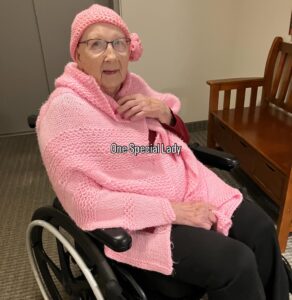
    Marjory, my mother-in-law.

    Making connections with others who are involved in the arena of caregiving can be comforting and supportive.  I will be posting free resources, online resources of other websites with resources you might find useful, videos, activities, and a list of books on the topics of caregiving, dementia, and Alzheimer’s.  However my posts and the resources I have developed will give you specific examples about how to actually apply information you find in various places. My site will offer hands on materials for you to download, activities that involve your loved one, even minimally, and specific ways you can manage by adapting your activities, care, and daily life around the need.

    Caregiving is an ever widening focus as the Baby Boomer Generation fills the beds provided by assisted living and nursing homes which can provide care. Here, I will talk about alternatives for that kind of care for the aging population, and share my personal experience.  Needing care can be a burden that is as heavy as that of giving care. The process for meeting the needs of one who requires care is not a straight path, and in fact is different for each case.   

    Giving honest information about exactly how caregiving can look, happen, and change daily, is my goal.  It is a very personal issue.  I have gained an understanding of how to live with it, how to meet the problems and make adaptations, and how to find the joy and peace that live just beneath the surface of the demands. As my life moves into the future with my mother-in-law, I will continue to have regular conversations with you about the ups and downs, management of life when you hit a wall, and real life practices anyone can implement.

    “Live for the moments that cannot be put into words.” Attributed to Clo Mailen